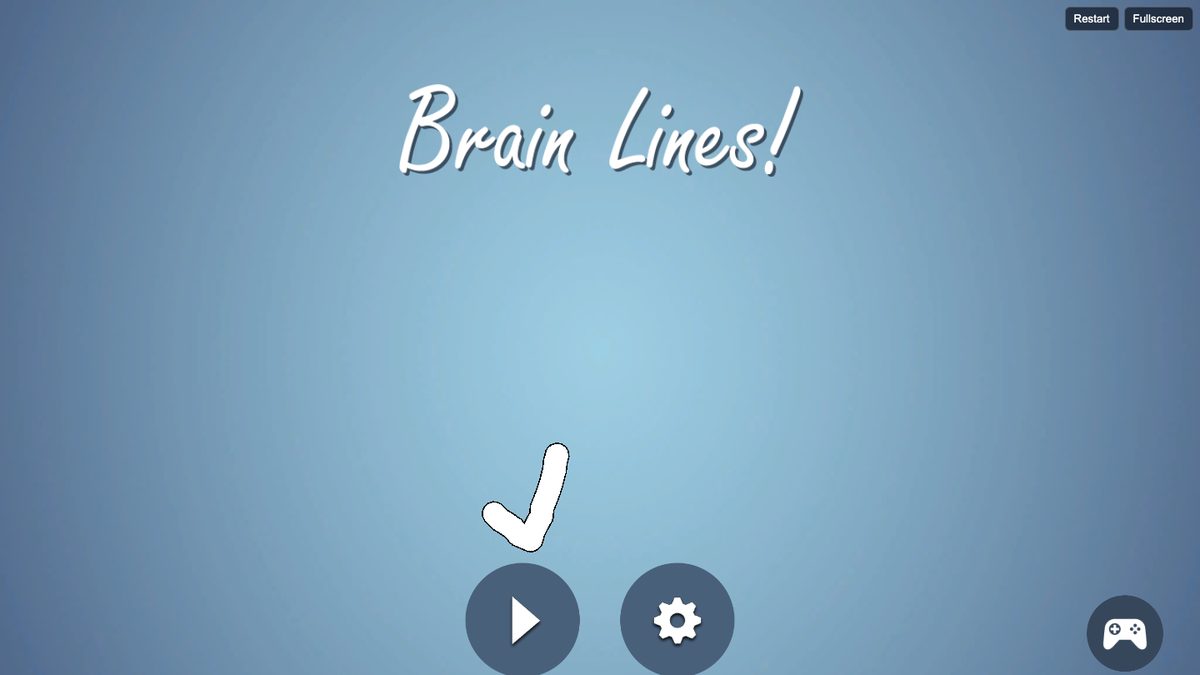
About Brain Lines
Brain Lines asks you to solve a level with a pencil stroke rather than a button. The play field accepts the line you draw, and the puzzle responds to the shape you left behind. That makes the first attempt a question rather than a failure: you learn how the level reacts to a curve, a slope or a short straight segment, then redraw with that in mind. The opening screen is deliberately plain, which keeps attention on the drawing itself instead of on a busy interface.
How the game works
Each level presents a situation and an objective, and the line you sketch is the tool that connects them. A stroke that is too steep, too short or drawn from the wrong side changes the outcome, so the interesting work happens before you lift your finger. Because a drawing is easy to replace, the game rewards quick experiments: draw, watch what happens, and redraw with one variable changed. Several short attempts usually teach more than one careful plan.
How to play
Open the player from this page and press the button on the title screen. When the level appears, drag across the play field to draw your line. Watch how the puzzle reacts, then draw again with a single change rather than rewriting the whole stroke. Small adjustments are easier to judge than large ones. Work through the levels in order, because each one tends to introduce one new idea that the next level builds on.
Practical tips
- Change one thing per attempt so you can tell what made the difference.
- Draw from the side that leaves you the most control near the objective.
- A shorter line is easier to judge than a long sweeping curve.
- Watch the puzzle react before you lift your finger; the response is the feedback.
- If a level stalls, redraw it from the opposite direction.
Frequently asked questions
How do you play Brain Lines?
You solve each level by drawing. The play field takes the line you sketch, and the puzzle reacts to its shape.
What are the controls?
Drag across the play field with a mouse or a finger to draw. The title screen has a single button to begin.
Do I need to be good at drawing?
No. The line is a shape rather than a picture, so a short straight segment or a simple slope is often enough.
Should I play the levels in order?
Yes. Each level introduces one idea, and the following level usually expects you to apply it.
What should I do when a level seems impossible?
Redraw it from the other direction with one change. Most stalls come from the angle of the first stroke rather than from the objective.
Guide written from playing this build on 2026-09-18. Game reference ↗